Search the Community
Showing results for tags 'automotive industry'.
Found 3 results
-
I was recently in Taiwan for a short getaway, and amidst the hiking, shopping and gastronomical indulging, naturally couldn’t pull my eyes away from the cars. One of the more interesting phenomena I noted on my first day already was just how dominant the Toyota Corolla Cross is. A quick search revealed that the car has been the island’s bestselling model for five years running – and is still going strong, with its numbers in 2025 representing a 32.6% jump year-on-year increase. But even more eye-catching was a brand badge I had never seen before in my life stuck onto a not insignificant number of cars: One bearing an ‘L’ in fancy font. Considering how widespread mainland Chinese brands have become, my mind initially went to "Oh, this must be another Chinese name I’ve never heard of" (a silly thought on retrospect, considering the fraught political relations between Taiwan and China). Some quick sleuthing, however, revealed the real answer: Luxgen. The beginnings of Luxgen In 2009, Luxgen emerged from the ambitious vision of Yulon Motor Company, Taiwan's largest automaker, which sought to establish the first Taiwanese car brand – and a distinct one at that, focused on innovation. Drawing from Yulon’s robust experience in building licensed Nissan models and importing well-known marques such as Infiniti and Renault, Luxgen cars were meticulously developed at the firm’s HAITEC research and development centre, bringing together local craftsmanship with global engineering prowess. This leap apparently represented not just a new chapter for the company, but for Taiwan's position in automotive history. Luxgen was birthed as the brain (First-generation Luxgen U6 pictured) The automotive space is one with high barriers to entry, so Luxgen naturally had to find a special way to stand out. Its initial strategy? Combining robust engineering prowess with advanced technology, to produce vehicles that would hopefully resonate with both domestic and international markets. It’s worth noting that Luxgen’s hope wasn’t built on thin air. By leveraging Yulon's existing infrastructure and resources, the homegrown marque was able to position itself uniquely within the automotive landscape, especially with their ‘Designed in Taiwan, Made in Taiwan’ branding. Luxgen quickly gained recognition, selling initially in Taiwan and Oman, and later expanding plans for production in China through a collaboration with Dongfeng Motor. With a focus on integrating cutting-edge technology, the first Luxgen models consistently reflected the brand's proactive approach to meeting evolving industry demands. The M7 - a mid-sized MPV - was the first model to be built by Luxgen (Image credit: Editorial Team) Luxgen’s first model Luxgen’s inaugural vehicle, the Luxgen7 MPV (later rebranded to the Luxgen M7), quickly exemplified this vision, debuting technology-forward innovations that set Luxgen apart in the industry. Among its standout features was an advanced onboard computer system co-developed by HTC (for the folks that still remember!) that integrated the car’s multimedia, navigation and telecommms functions, a panoramic camera and a blind-spot monitoring system, as well as a night vision feature that helped to enhance visibility in pitch-dark conditions. The Luxgen 7 also had a unique anti-theft seat that could slide forward on its on lean against the steering wheel – to resist getaway-car use. Interestingly, Wikipedia states that the Luxgen 7 EV+ even debuted as the world’s first electric MPV, featuring a 240hp electric motor (though not much in terms of electric range). Initially, Luxgen focused on creating vehicles that combined opulent features with cutting-edge technology, attracting mostly domestic attention. Over time, the brand expanded its lineup to include sedans, SUVs, crossovers, and MPVs, eventually branching into electric vehicles to align with global sustainability goals. The brand responded to market demands by extensively integrating electric and hybrid technologies, thus enhancing its portfolio and broadening its appeal. Its successful penetration of the Asia-Pacific, Middle Eastern, and Latin American markets indicates Luxgen’s adeptness at navigating competitive landscapes worldwide. Quick aside: Most popular Luxgen car models? Luxgen M7 MPV: As mentioned earlier, this was the torch-bearing pioneer in Luxgen's lineup, debuting as its flagship model upon launch in 2009. Inspired by the Renault Espace, the M7 catered to consumers seeking versatility and space. Though discontinued, its legacy as Luxgen’s first production model remains influential. The S5 remains the only sedan that Luxgen has built to date (Image credit: Wikimedia Commons) Luxgen S5: The Luxgen S5 sedan, introduced in 2012, was a milestone for the brand as its first self-developed Taiwanese car. Despite facing challenges, the S5 aimed to provide a compelling combination of advanced features and sleek design. Its ambition continues to resonate with those familiar with Luxgen's innovative roots. The U6 quickly established itself as a Taiwanese car market staple upon release (Image credit: Editorial Team) Luxgen U6: The Luxgen U6, a compact crossover introduced in 2013, quickly established itself as a staple in the Taiwanese car market. Crafted to combine performance with flexibility, it was offered with multiple engine options, including a turbocharged variant. Continuous updates in design and features have been rolled in a bid to keep the model relevant for both urban and suburban Taiwanese car-buyers. One of the later models to be introduced by Luxgen, the URX can seat up to seven (Image credit: Wikimedia Commons) Luxgen URX: Building on the U6 platform, the Luxgen URX entered the market in 2019 as a mid-sized crossover with the ability to seat up to seven. Known for its spacious interior and robust design, the URX has garnered attention for potentially being the first Luxgen model to reach European shores. The n7 is the first EV from Luxgen to ride atop of a Foxtron platform (Image credit: Wikimedia Commons) Luxgen n7: This one’s probably the most important one in the lineup today, since it marks Luxgen's foray into the electric vehicle sector. Unveiled to the tune of an impressive 25,000 pre-orders in 2022, the n7 symbolised the brand's push towards sustainability and innovation. A large part of its appeal comes from its apparently competitive pricing: The base model starts at NT$999,000 (approximately US$31,149), making it a cost-effective choice in the electric SUV market as detailed by the Taipei Times. Meanwhile, mid-range and top-tier trims are priced at NT$1.29 million and NT$1.34 million, respectively, offering various features and enhancements. Its allure has propelled it towards becoming the best-selling BEV in Taiwan. Upcoming Luxgen n5: Further headlines have been made by Luxgen with the upcoming N5. Set to launch in the burgeoning Taiwanese electric vehicle market by the end of 2025, the N5 is built on Foxtron's Model B platform. Initially planned to debut with 300 units for display and test drives in November 2025, Luxgen anticipates additional production in subsequent months. This vehicle integrates cutting-edge technology and is poised to enhance the brand’s presence in the competitive EV landscape. Luxgen never really established itself as a luxury brand despite its offering of bang-for-buck features and tech (Image credit: Wikimedia Commons) Is Luxgen a luxury car brand? Since its name seems to hint at it, it’s certainly valid to ask the question of whether Luxgen contains any luxury. And while the ambitions of luxury have certainly emerged over time (the brand has strived to integrate cutting-edge technology and modern design into its vehicles), Luxgen doesn’t quite appear to satisfy the conventional benchmarks associated with a luxury label. To give credit where it’s due, Luxgen did initially build its name on its ability to offer modern features (such as state-of-the-art infotainment systems and comprehensive safety measures) without the premium price tags typically associated with luxury vehicles. The approach gave it the ability to appeal to tech-savvy and budget-conscious consumers looking for affordable luxury options as detailed by Luxgen's profile. The U6 nameplate continues in the form of the U6 Neo today (Image credit: Wikimedia Commons) Models such as the U6 are still known for their advanced technological offerings and style, yet they are accessible at a competitive price point. Particularly, some online sources note that this approach helped to burnish their appeal early on in markets like the UAE, where consumers appreciated the blend of modern features and affordability against pricier Japanese and European models. In fact, the Luxgen U6 apparently still competes against the likes of the Honda HR-V and Mazda CX-30 in the UAE. However, Luxgen’s global presence remains limited, primarily due to challenges in long-term reliability and availability of parts outside Asian markets. Despite efforts to project a premium image, then, Luxgen remains more a savvy, tech-focused alternative rather than a definitive luxury car brand. Luxgen's future as its own independent car brand seems short, given its recent acquisition by Foxtron Vehicle Technologies (Image credit: Editorial Team) Recognition and future prospects: No more Luxgen…? For the better part of the nearly two decades during which it has been active so far, Luxgen was noted for consistently investing in R&D - a testament to its commitment to innovation, from autonomous driving to connectivity advancements. These efforts paid off most notably with Luxgen topping Taiwan's J.D. Power Customer Service Index multiple times. Here’s where things start to take a less luminous turn, though. Clearly, Luxgen’s global market presence remains limitet; in fact, it took a hit in 2020 with the announcement that it was withdrawing from the mainland Chinese market due to low sales. Concurrently, its reputation has also been challenged by past quality issues and a waning brand identity as documented by discussions on Luxgen's performance. The new Luxgen logo Furthermore, as efforts were made to fortify and future-proof the brand and embrace the future, its parent Yulon also started to collaborate more closely with Taiwanese tech firm, Foxconn. The result: A joint venture by the name of ‘Foxtron Vehicle Technologies’ established 2020, built on the goal of producing next-generation electric vehicles. Underpinning the Luxgen n7, in fact, is a Foxtron platform; ditto for the upcoming Luxgen n5. Then, in December 2025 (just last month!), Foxtron Vehicle Technologies announced that it would be acquiring Luxgen, with the US $25 million to see Foxtron “acquire 100 per cent of Luxgen, including its five sales subsidiaries, sales outlets and employees”, per a CNA article. The deal now unfortunately throws the future of Luxgen (as Taiwan used to know) up into the air. (Image credit: Wikimedia Commons) For what it’s worth, Foxtron is still a thoroughly homegrown brand, so it’s not that the sun is setting on the Taiwanese automotive industry yet, if at all. Still, one can’t help but feel some sense of loss at this turn of events - for a brand that once arguably exemplified Taiwan’s spirit of innovation and excellence, and which in challenging both bigger and more powerful players, as well as the status-quo of Taiwan’s car market itself. - Matt
-
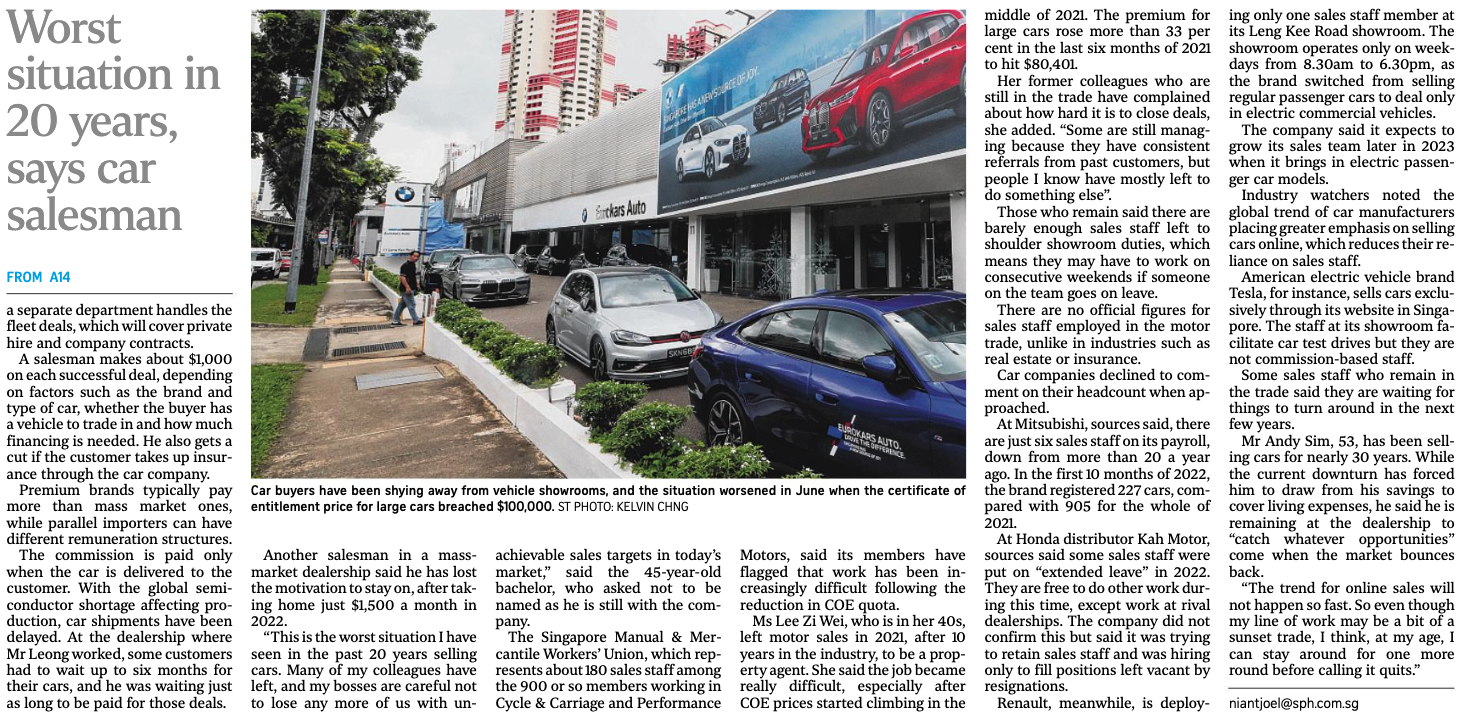
 Source: https://www.straitstimes.com/singapore/transport/this-is-the-worst-i-have-seen-in-20-years-quiet-showrooms-drive-many-car-sales-staff-out-of-industry?utm_keyword=dlvr.it They talk about online sale, I smell opportunity. 😈

- 227 replies
-
- 11
-

-

-

-
.png)
-
- the straits times
- automotive industry
- (and 1 more)
-
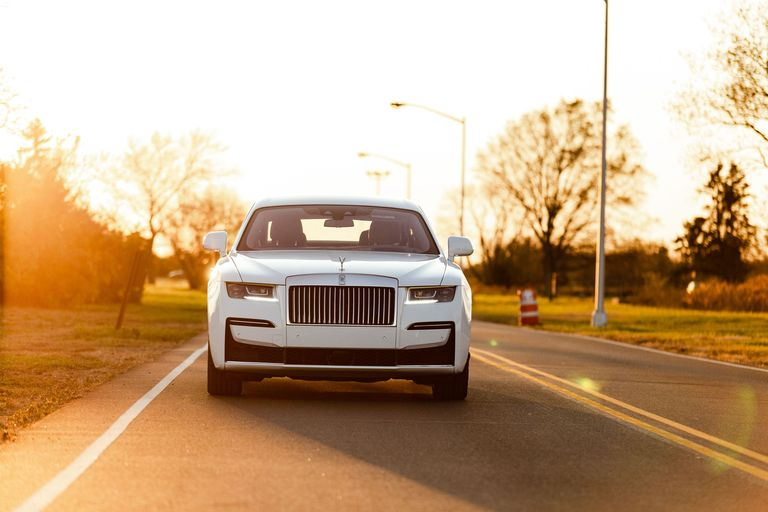
 https://www.roadandtrack.com/car-culture/a38090275/biggest-threat-from-electric-cars/ "Electric Cars Could Represent an Existential Threat for Luxury and Performance Brands Every company seems jazzed about the electric future. Think hard about market forces, though, and it’s obvious that someone is going to lose. How do you justify this many high-end car brands when every electric powertrain feels fundamentally the same? A question like that could kill a brand. Yet wandering the halls of the electric-oriented Munich auto show, you won’t find answers. You won’t even find anyone acknowledging the question. Here, the future is brilliant, boundless, and secure. Every brand is uniquely capable of winning. Every car is uniquely suited to its electric mission. And every executive can recite from memory the story of what will surely happen over the next decade. Getting out of one electric car demonstration drive and into another, though, I was unconvinced. Everyone cannot win. And the nature of electric cars likely means there can be fewer winners in the future. Evidence in favor surfaced in the Hyundai Ioniq 5. The electric crossover looks like an upsized Eighties hot hatch adapted for Cyberpunk, with an interior that could shame many concept cars. On the country lanes circling metro Munich, the Ioniq was brilliant. Its cabin was Cadillac quiet, its powertrain Rolls-Royce refined. Even in a lineup filled with all-stars, the Ioniq 5 is special. To deem the Hyundai as good as Mercedes’s flagship EQS electric mega-sedan would be an overstatement, of course. Going from the Hyundai to the Benz, there’s a palpable step-up, not just inside, but in the overall experience of the car. But it’s a gap that’s not quite big enough to keep sweat off the suits in Stuttgart. The Ioniq 5 might not be the match of the EQS, but it’s a hell of a lot closer than any middling Hyundai has ever been to the luxury stalwart, the Mercedes S-class. One core competency that unites the most conventionally successful premium brands is their mastery of the internal-combustion engine. McLaren and Porsche offer not just power but power that’s immediate and unending. Power with thunderous V-8 or wailing flat-six acoustic accompaniment. Rolls-Royce and Bentley, meanwhile, trade not only in suede and solidity, but smoothness and silence. As the industry shifts toward electric propulsion, these companies will inevitably continue to offer plenty of power, effortless acceleration, and total tranquility. Trouble is, so will Hyundai. So when whatever’s on the lot for $299 a month can get off the line without hesitation in its powertrain or vibrations through its seat rails, it’s hard to imagine how much more will the market bear for the driving experience of a Rolls-Royce. Surely names like Rolls-Royce and Mercedes stand for more than just engine refinement. Luxury brands have long differentiated themselves with stunning interiors, next-gen technology, seamless sales and service procedures, and exclusivity. But anyone with a cursory understanding of economics knows that the fewer differentiating factors there are to compete on, the tighter the margins will be in any market. This is why the endless variations of apples drive strong profits (have you seen what Honeycrisps go for?), while the genetic clone that is the common banana can be picked up for pennies. Electric motors are closer to the latter than the former. Every electric motor good enough to land in a current production car is torquey and linear. Some are permanent magnet, some are synchronous, but you’d never feel the difference if you weren’t told. EV powertrains can compete on how long they can draw from their batteries before they die, how efficient they are, or how well they’re tuned. Yet the fundamental experience is the same. Asked about how they’ll address this, different premium brands offer different not entirely satisfying answers. AMG says it’ll differentiate itself on tuning. BMW points to its in-house motors as a source of pride. Rolls-Royce ignores the email. Others have more to say in informal chats, but every major OEM stops short of admitting that someone’s going to get hurt. Because if you, as an automaker, acknowledge the obvious conclusion to the question, you may be expected to come up with a solution. No one seems close. It doesn’t take a trip to Munich to see it. Wander around any urban center and you won’t find it swarmed with I-Paces or e-trons. All you’ll see are gas cars and Teslas. It took an upstart to recognize that you didn’t need intricate interiors and unquestionable quality to stake a claim in the premium space. The EV experience was luxurious enough; all it took was that and a big touchscreen to convince the world that the brand selling the world’s simplest interiors was worthy of the luxury moniker. Less than a decade later, Tesla is the only EV that matters. For now, at least. It is all but impossible to build a successful business these days on sedans, unless of course the sedans have “Tesla” on the steering apparatus. The brand is so profoundly captivating that market trends seemingly do not apply. As the electric offerings from competitors improve, the homogeneity of the EV experience will threaten Tesla too. But its status as the default EV brand gives it some time to settle the matter. Those are the spoils of being the first company to understand the immense opportunity afforded by the switch to electric cars. Tesla hasn’t had to face the fundamental question here because it owns the space. In their rush to catch up, though, traditional automakers have become blind to the brewing threat of that very same transition. If they want to endure, they’ll have to find more unique, enduring visions beyond making their current cars electric. Otherwise, I’m not sure that the utopian vision from the auto show stands a chance at coming true."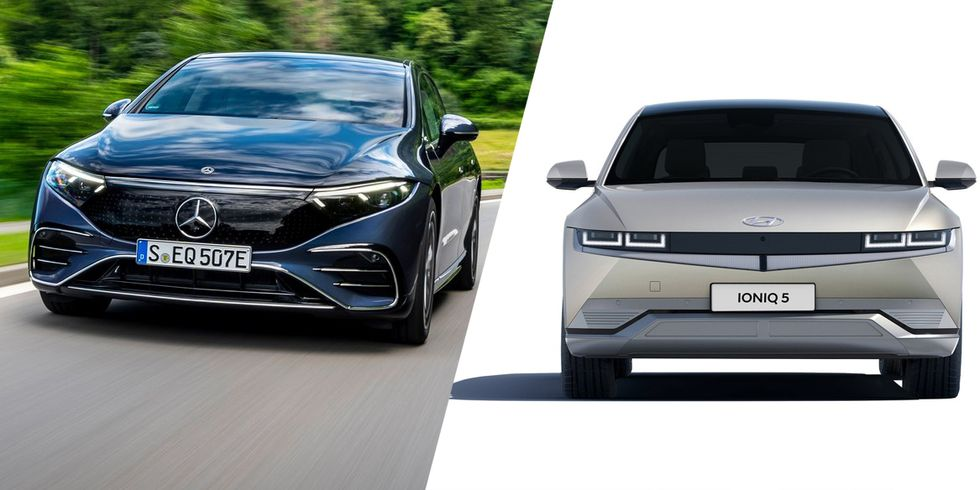



- 36 replies
-
- 3
-
-
- electric cars
- tesla
- (and 6 more)